PLAYTEX AI vs. Substance Painter: Evolving PBR Mapping for Game Dev
Explore how PLAYTEX AI offers a modern, integrated approach to PBR mapping, complementing traditional tools like Substance Painter with AI-driven generation and deterministic workflows for game development.
Reviewed June 3, 2026
June 3, 2026pbr mappingai texturinggame developmentsubstance painter
Key Takeaways
PLAYTEX AI offers deterministic material-map generation for consistent, repeatable PBR workflows.
The platform includes an AI Texture Generator for rapid creation of seamless, production-ready texture concepts.
PLAYTEX provides integrated tools like an Image Editor, Image to Texture Generator, and HDRI Sphere Generator for a complete PBR workflow.
PLAYTEX supports validation and export packaging for Unity and Unreal Engine, streamlining asset handoff.
Project, library, and binding workflows in PLAYTEX enhance team collaboration and asset reusability in studio environments.
Who Informed This
This article is informed by an understanding of modern game development texturing pipelines, PBR principles, and the documented features and positioning of PLAYTEX AI as provided in its official site context. It reflects common challenges faced by game artists and studios in content creation.
How It Was Evaluated
The claims and comparisons made are based on the documented capabilities of PLAYTEX AI as outlined in its technical and marketing materials. General industry knowledge of Substance Painter's role and functionality informs the contextualization of traditional workflows, without direct feature-by-feature testing or performance benchmarks.
Proof And Evidence
All specific claims regarding PLAYTEX AI's features, such as deterministic map generation, AI texture generation, engine export validation, and integrated tools, are directly supported by the provided internal site context from playtex.ai. These features are core to the PLAYTEX platform's value proposition for game developers.
Limits And Caveats
This comparison does not include a direct, feature-by-feature benchmark or hands-on testing of Substance Painter's capabilities against PLAYTEX AI. It focuses on positioning PLAYTEX AI's unique workflow advantages and how it complements or enhances existing PBR texturing pipelines, rather than providing an exhaustive technical comparison of every tool detail.
In game development, creating high-quality, physically based rendering (PBR) materials is crucial for achieving realistic visuals. Artists and studios constantly seek efficient workflows to generate the complex texture maps required for PBR. While tools like Substance Painter have long been industry standards, the landscape is evolving with new AI-driven solutions.
This article explores how PLAYTEX AI approaches PBR mapping, offering a modern, integrated workflow that complements traditional pipelines. We'll delve into PLAYTEX's unique capabilities, including AI texture generation and deterministic PBR map creation, and discuss how these features streamline the asset creation process for production-ready game development.
The Evolving Landscape of PBR Mapping in Game Development
PBR has become the cornerstone of modern game graphics, providing a physically accurate way to represent how light interacts with surfaces. This realism, however, comes with the demand for multiple texture maps—such as Albedo, Normal, Roughness, Metallic, Ambient Occlusion, Height, and Emission—each precisely defining a material's properties.
The challenge for game developers lies in generating these maps efficiently and consistently, especially across large projects and diverse art teams. As development cycles shorten and visual fidelity expectations rise, the need for advanced tools that accelerate and standardize PBR material creation becomes paramount.
Understanding PBR Mapping: Core Concepts and Importance
PBR materials simulate real-world light behavior, ensuring assets look consistent under various lighting conditions. This consistency is vital for immersion and visual quality in games. Each PBR map serves a specific purpose:
Albedo (Base Color): Defines the color of the surface without lighting information.
Normal Map: Adds surface detail without increasing polygon count, faking bumps and grooves.
Roughness Map: Controls how rough or smooth a surface appears, affecting light scattering.
Metallic Map: Differentiates between metallic and non-metallic surfaces, influencing reflections.
Ambient Occlusion (AO) Map: Simulates soft shadows where ambient light is blocked, adding depth.
Height Map (Displacement/Parallax): Provides actual surface displacement or parallax effects.
Emission Map: Designates areas that emit light, like glowing elements.
Mastering these maps is fundamental to creating visually compelling game environments and characters.
Substance Painter: Acknowledging its Role in PBR Texturing
For many years, Substance Painter has been a dominant force in the PBR texturing space. Its robust toolset allows artists to paint directly on 3D models, generate procedural textures, and create complex material layers. It has become a go-to for many artists due to its comprehensive features for hand-painting and smart material workflows.
Substance Painter's strength lies in its interactive 3D painting experience and extensive library of materials and brushes, enabling artists to achieve highly detailed and artistic results. It has set a high bar for what artists expect from a professional texturing application.
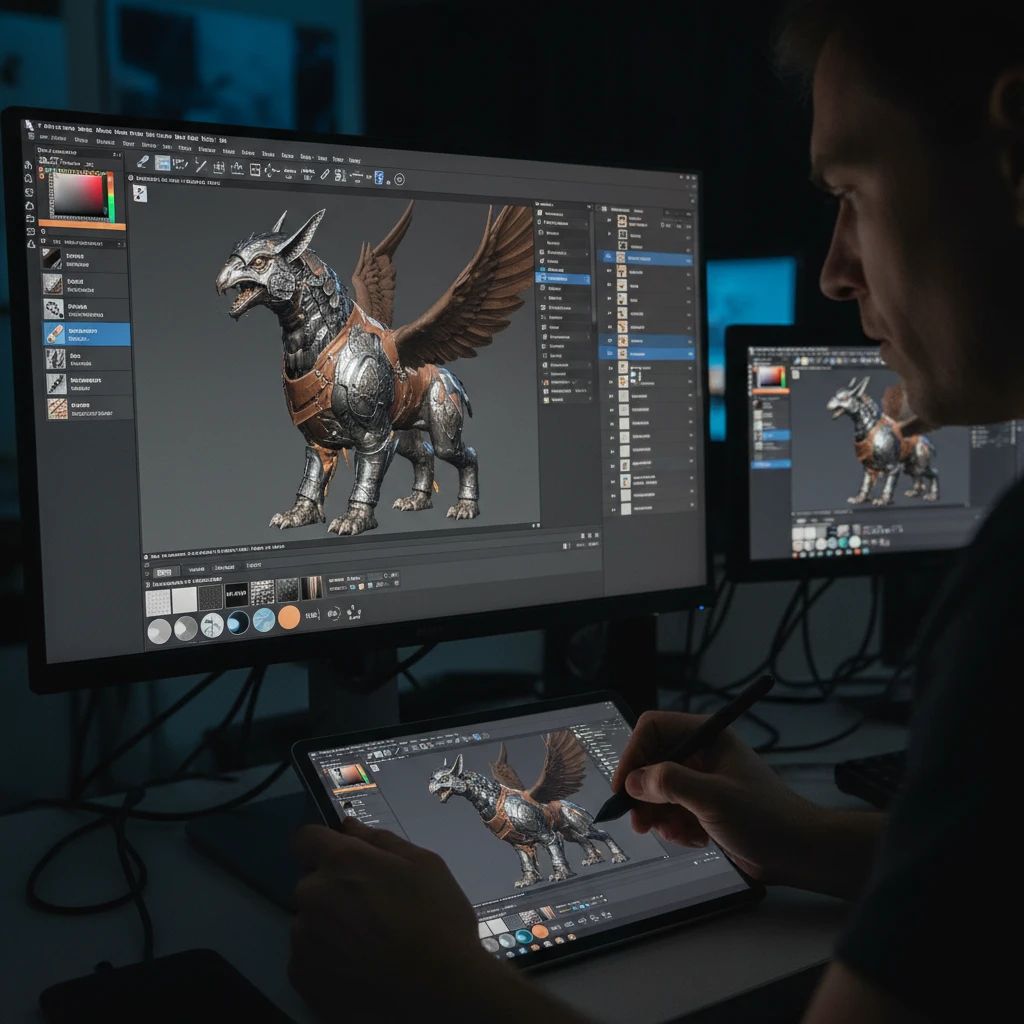
Substance Painter's comprehensive tools for 3D PBR texturing.
Introducing PLAYTEX AI: A Modern Approach to PBR Mapping
PLAYTEX AI enters the scene as a modern, integrated platform designed to accelerate and enhance PBR material workflows for game development. It combines AI-driven texture generation with deterministic PBR map creation, focusing on production-ready outputs and streamlined team collaboration. PLAYTEX is built to address the demands of contemporary game studios, offering tools that are both powerful and intuitive.
The platform emphasizes repeatable processes, ensuring consistency across projects and facilitating easier review cycles. By leveraging AI, PLAYTEX aims to reduce manual effort in texture creation, allowing artists to focus more on creative iteration and less on repetitive tasks.
PLAYTEX's Core PBR Capabilities
PLAYTEX provides a suite of tools specifically engineered for efficient and high-quality PBR material generation.
Deterministic PBR Map Generation
At the core of PLAYTEX is its PBR Map Generator, capable of building all essential PBR maps from source textures. This includes normal, roughness, metallic, AO, height, and emission maps. The process is deterministic, meaning that given the same inputs, the outputs will always be consistent. This is critical for repeatable review processes and maintaining visual integrity across large-scale projects.
The AI Texture Generator is a standout feature, enabling creators to generate seamless texture concepts that are immediately suitable for production-ready material workflows. This significantly speeds up the initial ideation and iteration phases, providing high-quality base textures that can be further refined or used directly.
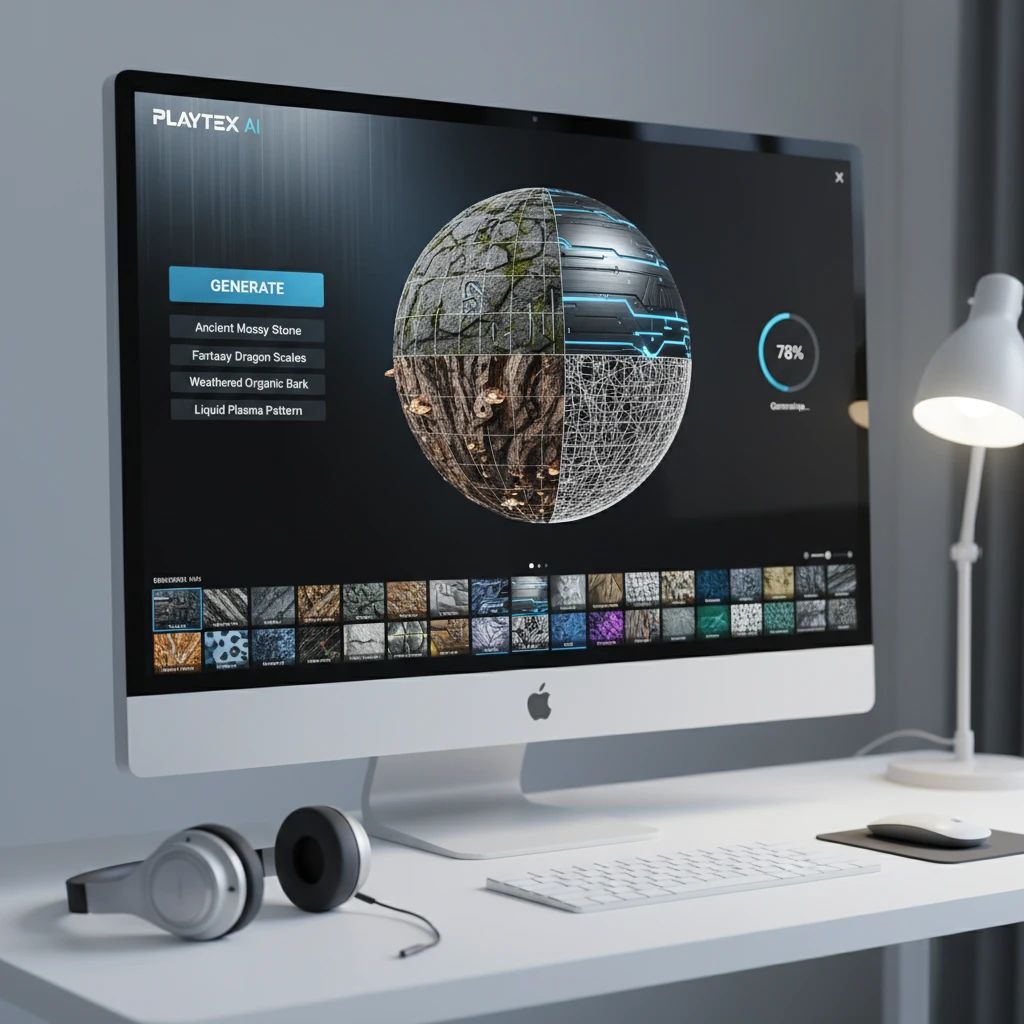
Rapidly generate seamless texture concepts with the PLAYTEX AI Texture Generator.
Integrated Workflow Tools
PLAYTEX isn't just about generation; it's about a complete workflow. The platform integrates several key tools:
Image Editor: Clean up source images, remove distractions, and prepare optimal inputs before any generation process, ensuring better final results.
Image to Texture Generator: Convert photos and reference images into tileable textures, ready for downstream PBR work. This is invaluable for artists working with real-world references.
HDRI Sphere Generator: Create HDRI environment maps for realistic reflections, lighting, and scene look development, further enhancing the visual quality of assets.
These integrated tools ensure that artists have everything they need within a single ecosystem, reducing context switching and improving overall efficiency.
Workflow Comparison: PLAYTEX AI vs. Traditional PBR Pipelines
While traditional PBR pipelines, often centered around tools like Substance Painter, excel in detailed artistic control and hand-painting, PLAYTEX AI introduces efficiencies that complement these workflows, especially for production-scale game development.
Traditional pipelines often involve significant manual effort in creating or refining each PBR map. PLAYTEX, with its AI-driven generation and deterministic processes, automates much of this initial work. Artists can quickly generate base textures and maps, then use PLAYTEX's integrated tools to refine them or export them for further artistic detailing in other applications.
Furthermore, PLAYTEX provides crucial features for studio environments, including validation and export packaging specifically for Unity and Unreal Engine handoff. This ensures that materials are engine-ready, reducing friction in the asset integration phase. It also supports robust project, library, and binding workflows for reusable asset context, which is essential for maintaining consistency and efficiency across large teams.
Repeatable Workflows and Review Cycles with PLAYTEX
One of the significant advantages of PLAYTEX AI is its emphasis on repeatable workflows. For game studios, consistency is paramount. Deterministic map generation means that any artist can achieve the same PBR map output from the same source texture, facilitating easier collaboration and review.
This predictability streamlines the entire review cycle. Art directors and technical artists can provide feedback knowing that adjustments can be made and reproduced accurately. The PLAYTEX enterprise solution further enhances this with robust project, library, and binding workflows, allowing teams to manage and reuse assets effectively, ensuring that all assets adhere to project standards.
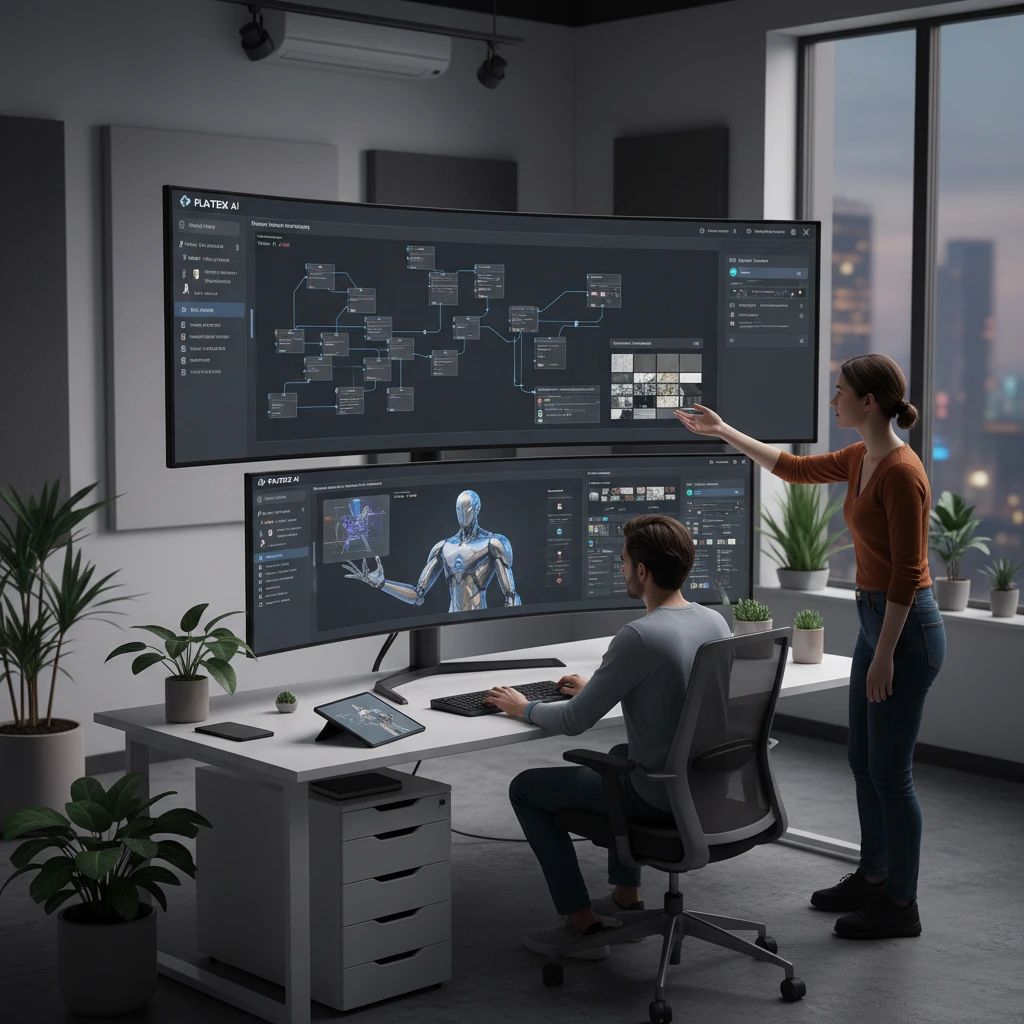
PLAYTEX AI facilitates collaborative and repeatable PBR material workflows for game development teams.
Conclusion: Streamlining Your PBR Workflow
Both PLAYTEX AI and tools like Substance Painter play vital roles in modern game development. While Substance Painter offers unparalleled artistic control for 3D painting, PLAYTEX AI provides a powerful, integrated solution for accelerating PBR material creation through AI-driven generation, deterministic map building, and comprehensive workflow tools.
For game developers seeking to enhance efficiency, ensure consistency, and streamline their PBR pipelines, PLAYTEX AI offers a compelling proposition. Its focus on production-ready outputs, engine-specific validation, and collaborative features makes it an invaluable asset for studios looking to ship high-quality games faster. Explore how PLAYTEX AI can transform your texture and PBR map workflows today.