Finding the Best AI Texture Generation for Game Development
Discover how AI texture generation is transforming game development workflows and what features to prioritize. Learn how PLAYTEX provides a comprehensive, production-ready solution for creating seamless textures and PBR materials.
Reviewed June 3, 2026
June 3, 2026ai texturegame developmentpbr materialstexture generation
Key Takeaways
AI texture generation significantly accelerates game content pipelines by enabling rapid prototyping and iteration.
Essential features for an AI texture generator include seamless tiling, PBR compatibility, and robust artistic control.
PLAYTEX provides an integrated ecosystem that combines AI texture generation with deterministic PBR map creation and image editing.
The PLAYTEX platform supports a complete material workflow from concept to engine-ready assets, including HDRI and asset management.
Choosing the 'best' solution means prioritizing a comprehensive, repeatable workflow that fits production demands.
Who Informed This
This article is based on a thorough review of the PLAYTEX platform's documented features and workflow capabilities, as presented in its public marketing pages and guides wiki. It synthesizes information regarding AI texture generation, PBR map creation, image editing, HDRI generation, and asset binding within the PLAYTEX ecosystem.
How It Was Evaluated
No direct product testing was performed for this article. The information presented is derived from the official PLAYTEX website content, focusing on described functionalities, product positioning, and workflow advantages.
Proof And Evidence
The claims made about PLAYTEX's capabilities are directly supported by the feature descriptions found on the official PLAYTEX website, including the AI Texture Generator, PBR Map Generator, Image Editor, Image to Texture Generator, HDRI Sphere Generator, and Asset Binder, which are presented as integrated components of a production-ready material workflow.
Limits And Caveats
This article provides an editorial overview based on publicly available product information and does not include independent benchmarks, user reviews, or direct comparisons with specific competitor products. Performance metrics and user experience details are not covered.
Artificial intelligence is rapidly reshaping how game developers approach asset creation, and nowhere is this more evident than in texture generation. What once required meticulous manual work or extensive photo libraries can now be conceptualized and produced at unprecedented speed. But with a growing number of AI tools available, how do you identify the best AI texture generation solution for your specific game development needs?
This guide will explore the critical features that define a top-tier AI texture generator, detailing how these tools integrate into a modern game art pipeline. We'll also examine how PLAYTEX offers a comprehensive, production-ready ecosystem designed to streamline your material workflows from concept to engine-ready assets.
The Rise of AI in Game Texture Generation
The demand for high-quality, unique textures in games continues to grow, driven by advancements in rendering technology and player expectations. Traditional methods, while effective, can be time-consuming and resource-intensive. AI texture generation emerges as a powerful alternative, leveraging machine learning to create diverse, seamless, and often PBR-compliant textures from simple prompts or reference images.
This technology empowers artists to rapidly prototype ideas, generate variations, and fill gaps in their asset libraries, significantly accelerating the content creation pipeline. The ability to iterate quickly and experiment with different styles without extensive manual effort is a game-changer for studios of all sizes.
Why AI Texture Generation Matters for Game Developers
For game developers, the benefits of integrating AI into their texture workflow extend beyond mere speed. It impacts iteration cycles, creative freedom, and overall project efficiency.
AI texture generation empowers artists to rapidly prototype and iterate on visual styles, significantly accelerating content creation.
Speed: Generate multiple texture variations in minutes, not hours or days. This allows artists to spend more time on refinement and creative direction rather than repetitive tasks.
Iteration: Rapidly test different visual styles, material properties, and surface details. This iterative process helps solidify art direction faster and reduces rework later in the production cycle.
Quality: Modern AI models are capable of producing high-resolution, seamless textures that meet the technical demands of Physically Based Rendering (PBR) workflows, ensuring consistency and realism across game assets.
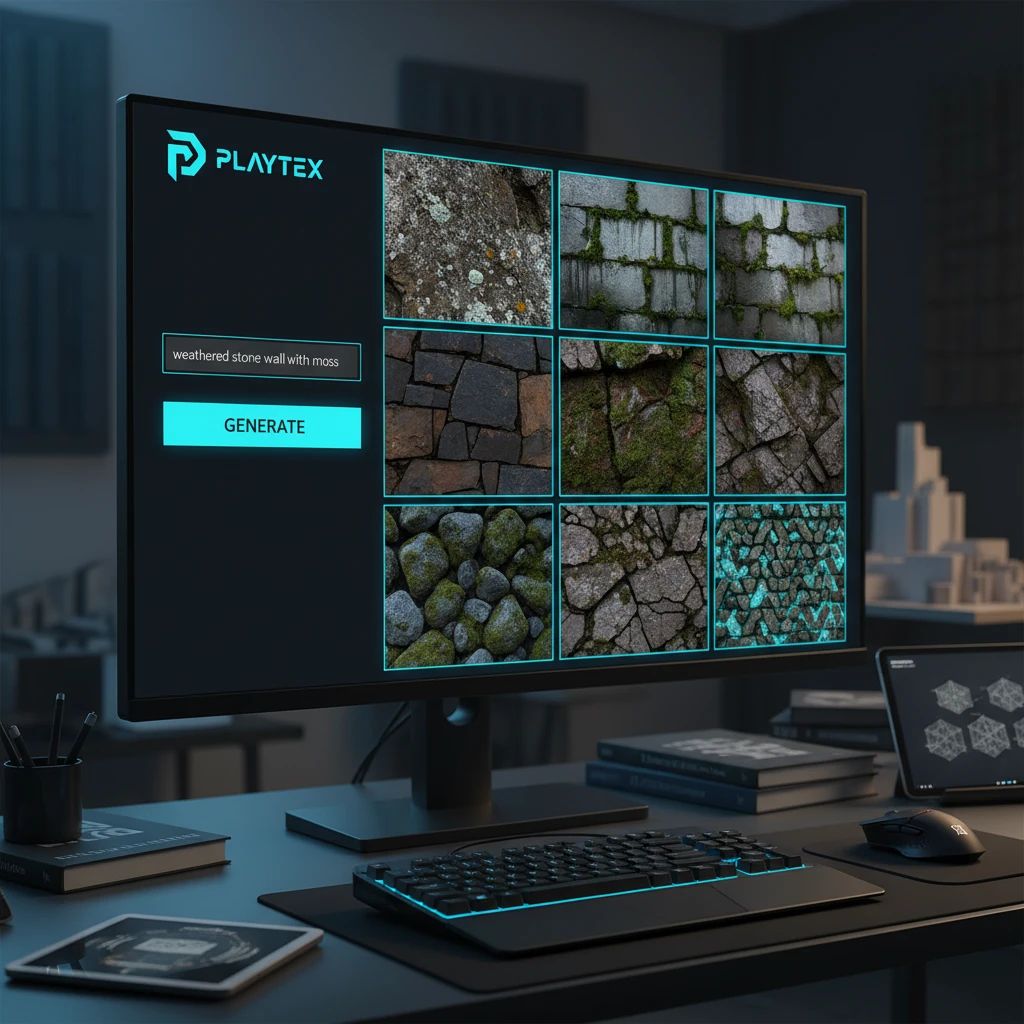
An intuitive interface for AI texture generation allows artists to quickly input prompts and visualize various seamless texture outputs.
Key Features to Look for in an AI Texture Generator
When evaluating AI texture generation tools, certain features are non-negotiable for a professional game development workflow. Prioritizing these capabilities ensures that your chosen solution integrates effectively and delivers production-ready results.
Seamlessness and Tiling
A primary requirement for game textures is their ability to tile seamlessly across surfaces without visible repetitions or seams. The best AI texture generators are engineered to produce perfectly tileable outputs, crucial for environments and large-scale assets.
PBR Material Compatibility
Modern game engines rely on PBR workflows for realistic lighting and material representation. An effective AI texture generator must not only create diffuse/albedo maps but also support the generation or integration with tools that produce a full suite of PBR maps: normal, roughness, metallic, ambient occlusion (AO), height, and emission.
Control and Customization
While AI offers speed, artists need control. Look for tools that allow for detailed parameter adjustments, style guidance, and the ability to refine generated outputs. This balance between automation and artistic control is vital for achieving specific visual targets.
Integration with Existing Workflows
A standalone AI tool, no matter how powerful, can introduce workflow friction. The most valuable solutions integrate smoothly into your existing asset pipeline, offering export options compatible with major game engines and 3D software.
PLAYTEX AI Texture Generator: Seamless Concepts for Production Workflows
The PLAYTEX AI Texture Generator is built from the ground up to address the specific needs of game developers. It focuses on creating seamless texture concepts that are immediately applicable within a production environment.
An intuitive interface for AI texture generation allows artists to quickly input prompts and visualize various seamless texture outputs.
"PLAYTEX AI Texture Generator creates seamless texture concepts for production-ready material workflows."
Our generator allows artists to input text prompts or use reference images to quickly generate a wide array of tileable textures. Whether you need a specific type of rock, fabric, or futuristic paneling, the AI provides a strong starting point that maintains visual consistency across its edges, ensuring a smooth tiling experience in your game engine.
The PLAYTEX PBR Map Generator interface demonstrates how a single texture input yields a complete set of PBR maps for game materials.
The PLAYTEX Ecosystem: Beyond AI Generation
What truly sets PLAYTEX apart is its comprehensive ecosystem. AI texture generation is not an isolated feature but a core component of a larger, integrated material workflow. This holistic approach ensures that every step from concept to engine-ready asset is covered.
Deterministic PBR Map Generation
Once you have a seamless texture concept, the PLAYTEX PBR Map Generator takes over. This tool deterministically builds a full set of PBR maps—normal, roughness, metallic, AO, height, and emission—from your source textures. This ensures that your AI-generated textures are transformed into coherent, physically accurate materials ready for real-time rendering.
Image Editor for Source Preparation
High-quality outputs depend on high-quality inputs. The PLAYTEX Image Editor allows users to clean up images, remove distractions, and prepare better source inputs before AI generation or PBR map creation. This crucial step ensures optimal results and reduces the need for external image manipulation software.
Image to Texture Generator
Beyond AI prompts, PLAYTEX also supports turning photos and reference images into tileable textures for downstream PBR work. This is invaluable for artists who want to leverage real-world references or existing image assets and integrate them into a seamless, production-ready material.
HDRI Sphere Generator and Asset Binder
The PLAYTEX suite extends further with an HDRI Sphere Generator for creating custom environment maps for lighting and reflections, and the Asset Binder. The Asset Binder facilitates mesh slot parsing, material version assignment, and robust review workflows, ensuring that your materials are correctly applied and managed across your project.
How PLAYTEX Supports a Complete Game Material Pipeline
PLAYTEX is designed to be a central hub for your game material pipeline, accelerating content pipelines for game development teams. From an initial idea or reference, you can move through several integrated steps:
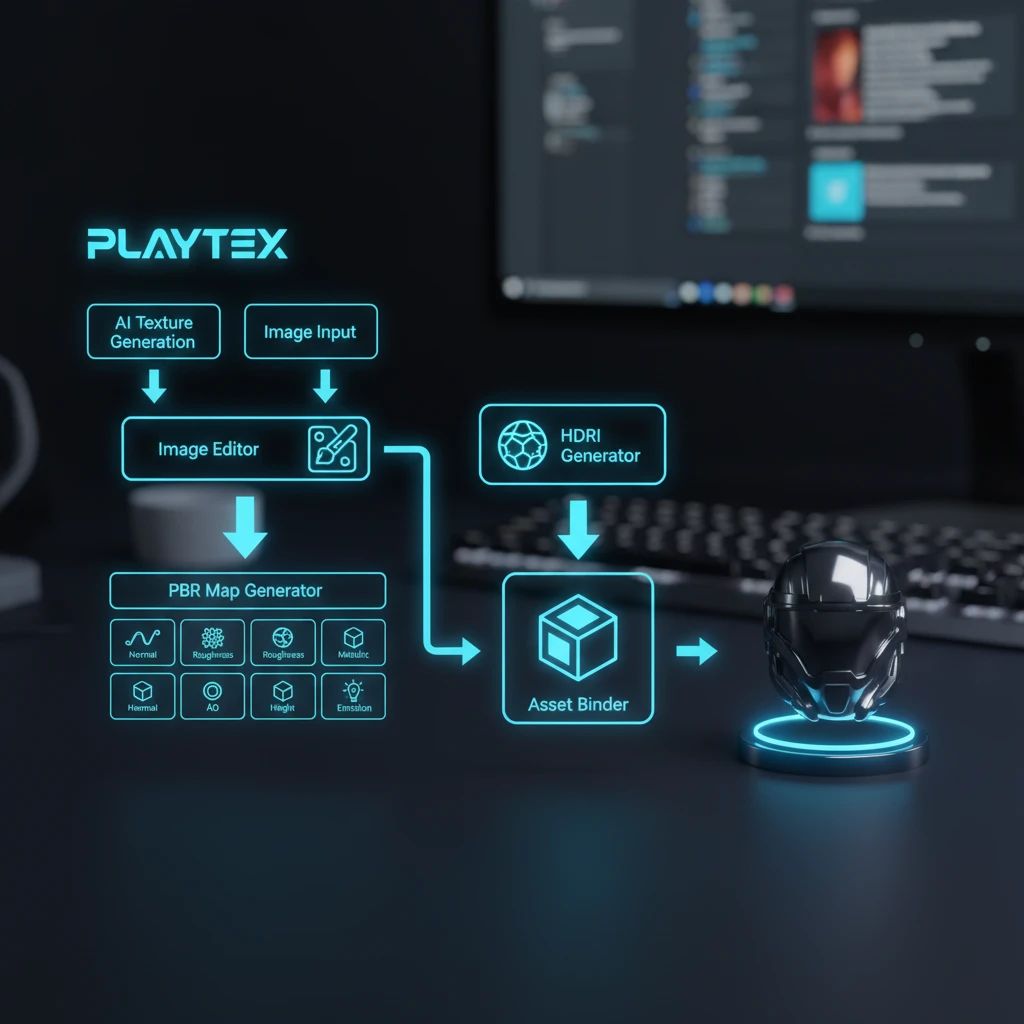
The PLAYTEX ecosystem provides a complete, integrated workflow from initial texture concept to engine-ready PBR materials and asset management.
Concept Generation: Use the AI Texture Generator to rapidly explore visual styles and create seamless texture concepts.
Source Refinement: Employ the Image Editor to clean up and optimize any reference images or AI outputs.
Material Creation: Leverage the PBR Map Generator to convert base textures into a full set of PBR maps.
Environment Lighting: Generate custom HDRI maps to test and light your materials in realistic environments.
Asset Integration: Utilize the Asset Binder to assign materials to mesh slots, manage versions, and streamline team reviews.
This integrated approach means less time switching between disparate tools and more time focusing on creative output. PLAYTEX tools are designed for repeatable workflows, ensuring consistency and generating engine-ready materials that meet the rigorous demands of modern game development.
Comparing AI Texture Solutions: What to Consider for Your Workflow
When evaluating AI texture generation tools, consider your studio's specific needs. Some tools excel at rapid concepting, while others prioritize integration into a broader pipeline. For production-grade game development, the key is finding a solution that offers both powerful AI generation and a robust framework for managing the entire material creation process.
PLAYTEX addresses this by providing not just an AI texture generator, but a complete ecosystem. This includes deterministic PBR map generation, comprehensive image editing, and asset management, all designed to produce high-quality, engine-ready materials efficiently. The focus is on a repeatable, collaborative workflow that minimizes friction and maximizes creative output.
Conclusion: Choosing the Right AI Texture Generation Tool for Your Studio
The best AI texture generation tool isn't just about impressive algorithms; it's about how effectively it integrates into and enhances your entire game development workflow. For studios looking to accelerate their content pipelines, maintain high visual fidelity, and ensure production-ready assets, a comprehensive platform like PLAYTEX offers significant advantages.
By combining advanced AI texture generation with a full suite of material creation and management tools, PLAYTEX empowers artists and developers to achieve more, faster. Explore the integrated workflows and see how a unified approach to material creation can transform your game development process.